



As enterprises adopt increasingly autonomous AI systems, traditional governance models are proving too static to keep pace with emerging risks, regulatory change, and growing accountability demands. Info-Tech Research Group’s new blueprint, Establish Your Adaptive AI Governance Program: From Principles to Practice, outlines a practical, ten-phase approach to help organizations govern AI dynamically across its lifecycle while balancing innovation with accountability.
ARLINGTON, Va., May 1, 2026 /PRNewswire/ – Traditional AI governance models are becoming less effective as organizations adopt agentic AI systems that can reason, act, and adapt with increasing autonomy. To help IT leaders respond, Info-Tech Research Group has published its blueprint, Establish Your Adaptive AI Governance Program: From Principles to Practice, designed to help organizations build AI governance that evolves alongside emerging risks, technologies, and regulatory requirements.
According to Info-Tech’s findings, governance approaches built around periodic reviews or siloed compliance functions are struggling to keep pace as AI systems move beyond narrow, task-specific use cases. The firm’s blueprint introduces adaptive AI governance as a dynamic, system-oriented model that integrates continuous monitoring, real-time risk detection, and feedback loops throughout the AI lifecycle.
The blueprint also emphasizes that adaptive AI governance cannot be treated as a compliance-only function. As agentic AI systems become more autonomous, organizations face growing pressure to clarify accountability, strengthen oversight, and ensure governance can respond in near real time without slowing innovation.
“Adaptive AI governance represents a fundamental shift from static oversight to continuous, system-level governance,” says Bill Wong, research fellow at Info-Tech Research Group. “As agentic AI systems become more autonomous, organizations need governance frameworks that can evolve in near real time to address emerging risks while still enabling value creation.”
Info-Tech’s Ten-Phase Framework for Adaptive AI Governance
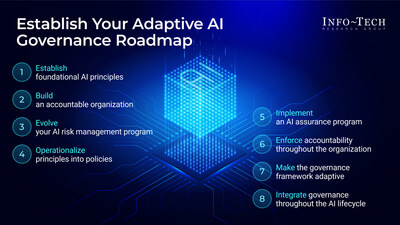
Info-Tech’s Establish Your Adaptive AI Governance Program: From Principles to Practice blueprint provides a structured, end-to-end methodology that guides organizations through ten key phases required to build and sustain an adaptive AI governance program:
- Assess current AI governance capabilities.
- Establish the organization’s foundational AI principles.
- Establish the organization’s AI governance structure.
- Develop an AI risk and compliance program.
- Implement AI policies to operationalize the foundational AI principles.
- Develop an AI assurance program.
- Ensure accountability for every AI application.
- Implement an adaptive and resilient AI governance framework.
- Integrate AI governance into the AI lifecycle.
- Build the adaptive AI governance roadmap.
Together, these phases help organizations move beyond ad hoc or siloed governance efforts and embed governance across all stages of the AI lifecycle, from planning and design through deployment, monitoring, and eventual decommissioning.
Info-Tech’s resource further emphasizes that adaptive AI governance is a shared organizational responsibility, requiring participation from executive leadership, legal and risk teams, developers, data scientists, and other stakeholders. By integrating governance throughout the AI lifecycle, organizations can proactively identify governance gaps, strengthen alignment with foundational AI principles, and respond more effectively to changing regulatory and technological conditions.
The global research and advisory firm’s blueprint is supported by practical tools that help organizations operationalize governance, including an AI governance maturity assessment, AI risk assessment templates, AI policy and committee charter templates, and an executive-ready roadmap presentation. Together, these materials help leaders translate governance principles into actionable practices that support both responsible AI use and measurable business value.
For timely and exclusive commentary from Info-Tech’s experts, including Bill Wong, and access to the complete Establish Your Adaptive AI Governance Program: From Principles to Practice blueprint and supporting tools, please contact [email protected]
Info-Tech Research Group is the “get things done” partner for over 30,000 IT, HR, and marketing leaders worldwide. The fastest growing research and advisory firm, Info-Tech enables leaders to make well-informed decisions and transform their organizations through AI, strategic foresight, step-by-step methodologies, practical tools, industry-leading advisory, and training programs. For nearly 30 years, tens of thousands of private and public organizations have trusted Info-Tech to lead their most important initiatives through periods of change and deliver outcomes that truly matter.
To learn more about Info-Tech’s HR research and advisory services, visit McLean & Company, and for data-driven software buying insights and vendor evaluations, visit the firm’s SoftwareReviews platform.
Media professionals can register for unrestricted access to research across IT, HR, and software, as well as hundreds of industry analysts through the firm’s Media Insiders program. To gain access, contact [email protected].
For information about Info-Tech Research Group or to access the latest research, visit infotech.com and connect via LinkedIn and X.

 View original content to download multimedia:https://www.prnewswire.com/news-releases/agentic-ai-exposes-the-limits-of-static-governance-models-warns-info-tech-research-group-302760441.html
SOURCE Info-Tech Research Group

Featured Image: DepositPhotos @ Neliana